
01
After every feature
Each new story brings acceptance criteria that someone checks step by step, by eye.
PROOFTRACE
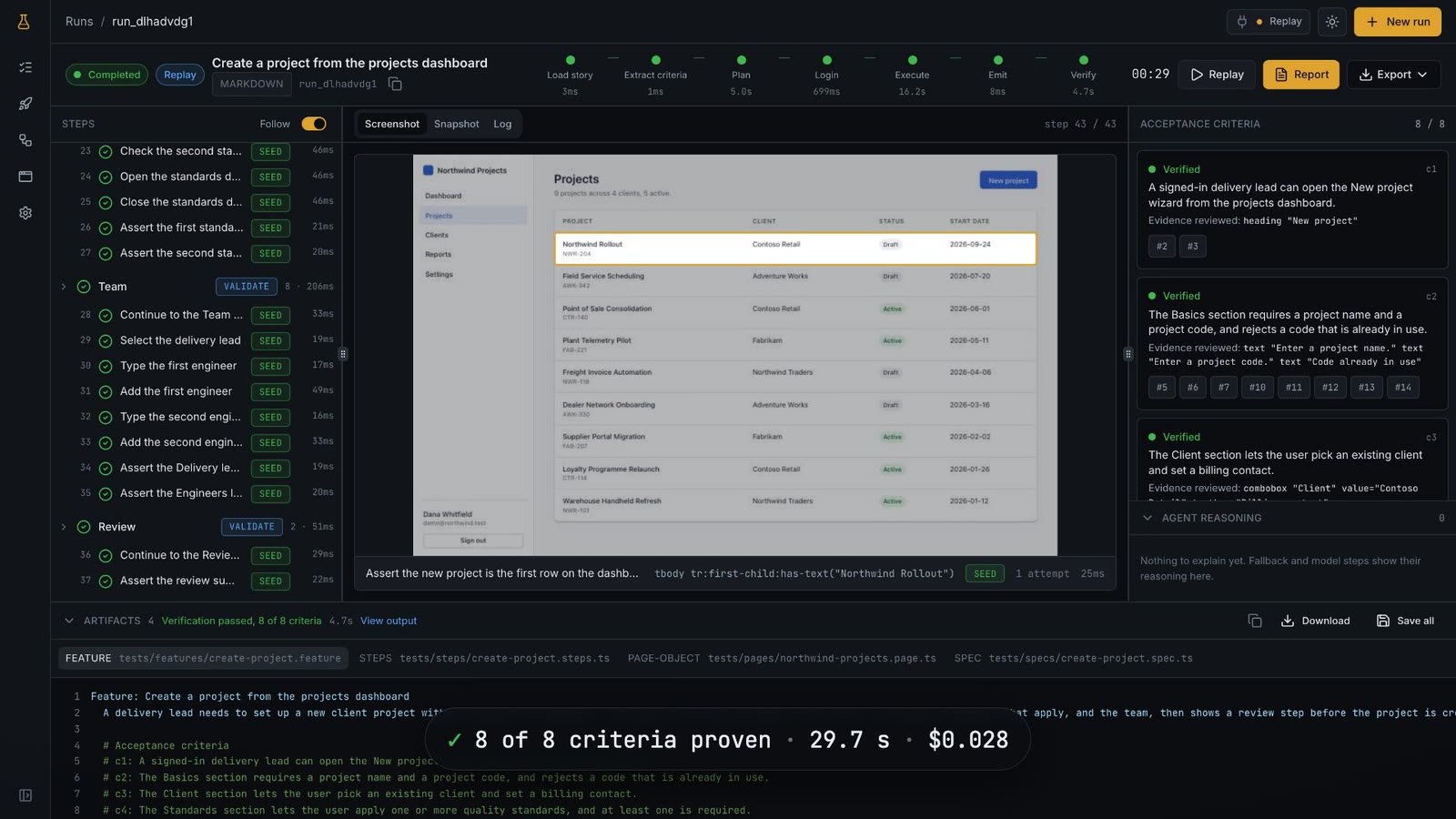
Give it a user story. It opens your app in a real browser, does what the story describes, and proves each acceptance criterion with a screenshot of every step. Then it hands back a Gherkin feature and a Playwright test your team can rerun on any environment.
$ prooftrace run --story stories/create-project.md
passed: 8 of 8 criteria · 29.7 s · $0.028
THE GAP
Every feature ships with acceptance criteria, and someone has to prove each one works. That means a test engineer clicking through the app after every deployment, then doing it all again in dev, in UAT and in production. It is slow, it never stops, and it is where most development teams fall behind.
01
Each new story brings acceptance criteria that someone checks step by step, by eye.
02
The same checks run again in dev, in UAT and in production, after every deployment.
03
Turning them into automated tests takes days, and the tests drift as the app changes.
Prooftrace automates that work, for a few cents a run.
It reads the acceptance criteria straight from the user story and proves each one in a real browser. Then it hands back two files: a Gherkin feature anyone can read, and a Playwright test anyone can rerun on dev, UAT or production with no AI cost. Stories come from Markdown files and GitHub issues today, with Jira and Azure DevOps next.
HOW IT WORKS
loads the story from a Markdown file or a GitHub issue.
pulls out each acceptance criterion.
matches a saved recipe, or decides to explore.
logs in; the AI never sees the password.
drives a real browser, a screenshot per step.
writes a Gherkin feature and a Playwright test.
runs the tests and marks each criterion proven or not.
WHO ACTS ON A STEP
A REAL RUN
The interactive replay loads here
Recorded with OpenAI's gpt-4.1 against a sample app. Every screenshot, click and check is real. Press Replay in the console to watch the run again.
TRUST BY DESIGN
No proof, no pass.
A criterion passes only when an assertion linked to it passes in the generated test. Actions alone prove nothing, and a run with an unproven criterion is a failed run.
01
A page asks the AI to type the password somewhere else
✓ The password fills only password fields, on the app's own site.
02
The AI is steered to another website
✓ Navigation stays on the app's own site.
03
Page text poses as instructions
✓ Everything on the page is treated as data.
04
A story title smuggles code into generated tests
✓ Every text is encoded; locators are parsed, never pasted.
05
Generated tests try to read your API keys
✓ The test process gets an allowlisted environment.
06
A website rebinds its domain to your local server
✓ The server answers only to its own addresses.
07
A website opens a WebSocket to your local server
✓ Connections from any other site are refused.
08
A project's settings file swaps the browser program
✓ It may only supply the settings the config names.
09
A GitHub reference tries to climb out of its path
✓ It is rejected before any request is made.
NUMBERS
29.7 s
Create a project: 43 steps, 8 of 8 proven, $0.028
10.7 s
Sign in with no recipe: the AI explored, 3 of 3 proven, $0.017
$0
The same recipe with the AI switched off: 16.3 s, 8 of 8 tests pass, no evidence review
OpenAI gpt-4.1 against the sample app, September 2026.
ARCHITECTURE
Engine
HOW IT WAS BUILT
01
Acceptance criteria should prove themselves, not wait for someone to click through them.
02
Seven stages, a typed event stream, and adapters for everything outside it.
03
Live runs changed the design: the AI learned to read page text, to assert evidence, and to fail honestly.
04
Nine security issues found by probing the code, each fixed and probed again.
05
Recorded runs you can click through, and code access on request.
18
tasks shipped
320+
automated tests
9
security issues fixed
Like what you see?
CODE ACCESS
The source is private. Tell me who you are and I'll send you read-only access on GitHub for 7 days.
Used only to grant access, and deleted after 30 days.
Every criterion proven. Every step on record.